Is Your Cleanroom Clean Enough?
Updated: Sep 28
Most cleanrooms pass their first certification and then quietly change. Production ramps up, equipment gets added, staffing shifts, filters load with particles, and the room that met its classification on day one may not be meeting it today. Asking whether your clean room is clean enough is really a question about evidence: what your classification actually requires, what your testing shows, and whether anything has changed since the last time someone checked. A missed classification can mean lost product, failed audits, and expensive rework, so it pays to know where you stand before an inspector or a failed batch tells you.

Table of Contents
Is Your Cleanroom Clean Enough? What the Standards Actually Measure
Clean enough has a specific meaning. ISO 14644-1 classifies air cleanliness by the concentration of airborne particles at defined sizes, ranging from 0.1 to 5 micrometers, across nine classes. ISO Class 1 is the cleanest and ISO Class 9 is the least strict. A room's classification is a claim about particle counts measured at designated sampling locations, so the number on your certificate only means something if the measurements behind it are current and were taken under conditions that match how you actually operate.
That last point catches people out. A room can pass while empty and idle, then exceed its limits once staff, equipment, and material movement are added. So is your cleanroom clean enough? The honest answer depends on the occupancy state that was tested, not just the class printed on the paperwork.
The quality of the measurement matters as much as the result. Particle counters need to be calibrated, sampling locations need to be chosen according to the current edition of the standard, and results need to be documented in a way an auditor can follow. A stale count from an out-of-calibration instrument can undermine an otherwise clean record, which is why many facilities keep calibration and testing schedules aligned.
ISO 14644-2 covers the other half of the picture, which is monitoring to show continued compliance. Its 2015 edition places emphasis on having a planned monitoring strategy rather than relying only on periodic testing. How often a room needs testing depends on its class, its industry, and the facility's quality system, and many regulated operations combine scheduled testing with continuous monitoring in their most critical zones. Depending on your industry, additional requirements sit on top of ISO, such as USP 797 and USP 800 for pharmaceutical compounding spaces.
Filtration and Airflow Are Where Problems Usually Start
Filters are the first line of defense, and they change over time. HEPA and ULPA filters remove particles as air enters or recirculates through the room, but a filter that is intact is not the same as a filter that is performing. Loaded filters restrict airflow, and even a small leak around a filter housing can let particles bypass filtration entirely. Integrity testing methods are described in ISO 14644-3, and they exist because a filter can look fine and still fail in service.
Air change rates deserve a clarification, because they are often described as an ISO requirement. ISO 14644-1 does not set a required number of air changes. The rate is a design decision, chosen so the room can hold its classification, and it should be verified by measuring airflow rather than assumed. If the rate is too low for the current process, contaminants linger and particle counts creep up. If processes or equipment have changed since the original design, the airflow that was right at commissioning may no longer be enough.
Pressure relationships matter here too. A clean room needs to keep a defined pressure difference from adjoining spaces so air moves from cleaner areas toward less clean ones. Door discipline, airlock function, and sealed penetrations all affect whether that relationship holds during a busy shift, and a cleanroom that looks fine on a quiet afternoon can behave very differently when doors are cycling constantly.
Temperature, Humidity, and the Heat People Add
Temperature is easy to overlook until production increases. Every person in the room gives off heat, and so does every piece of electronic equipment. When a process ramps up, that combined load can push temperature beyond the limits set in your operating procedures, especially if the HVAC system was sized for the original, smaller workload.
The consequences go beyond comfort. Heat can change how chemical or biological materials behave, which means the results of a process may drift from what you intended. Warm employees also perspire, which raises humidity and adds a possible source of contamination. Humidity that runs high encourages microbial growth, while humidity that runs low can create static problems around sensitive electronics.
The practical takeaway is to check your cooling and humidity control against current conditions, not the conditions from the original design. A system with no headroom will struggle the moment production grows, and adding capacity after the fact usually costs more than building in a margin during design.
Warning Signs a Clean Room Is Drifting Out of Spec
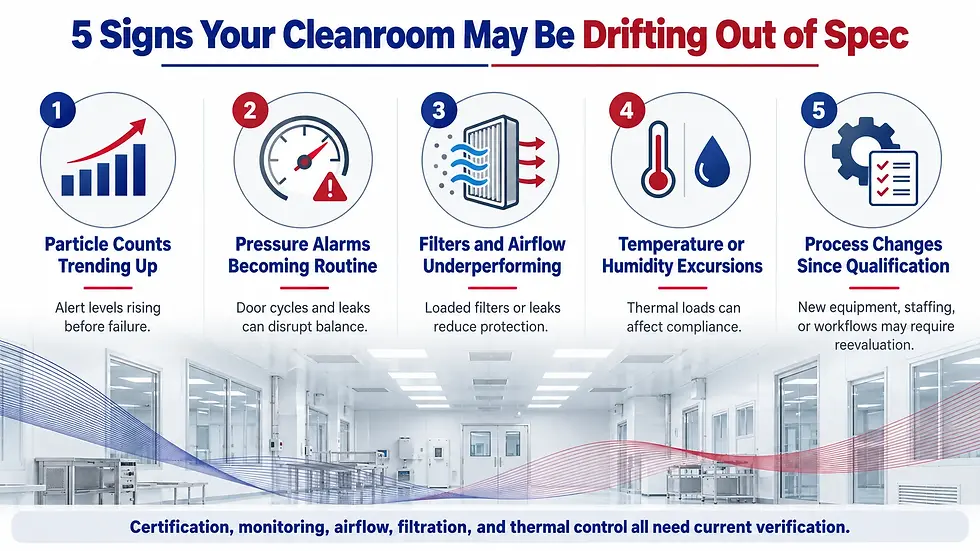
Rooms rarely fail all at once. They drift, and the signs are usually visible in data you already collect. Particle counts that trend upward toward alert limits, even if they have not crossed them, deserve attention. So do pressure alarms that have become routine, filters that need replacing more often than they used to, and temperature excursions that cluster during peak production.
Process outcomes matter as well. Rising rejects, unexplained yield changes, or contamination findings with no obvious source can all point back to the environment. Any significant change since your last qualification should also prompt a fresh look, including new equipment, a different process, added headcount, or modifications to the space. Overdue recertification is a warning sign in its own right, since a certificate that is out of date tells you very little about the room's condition today.

Getting Answers with DesignTek Consulting
Working out whether a room is truly meeting its standards takes people who understand both the standards and the systems behind them. DesignTek Consulting designs and builds clean rooms and evaluates existing ones, so our engineers can look at classification, filtration, airflow, and thermal loads together instead of treating them as separate problems.
If you are unsure where your facility stands, contact us to learn more about our services and how an evaluation can identify gaps before they turn into lost product. It is far less costly to find a drifting cleanroom early than to explain a failed batch later, and a well-run evaluation gives your team a clear, documented picture of what needs attention first.


Comments