Temperature and Humidity Control for Sensitive Manufacturing
Walk into any facility built for sensitive manufacturing and you'll notice something right away: the air feels different. It's not just clean; it's controlled. Every degree of temperature, every percentage point of humidity has been carefully thought through. That's not an accident. It's the result of disciplined cleanroom engineering, and it makes all the difference between a product that meets spec and one that doesn't.

Table of Contents
Why Environmental Control Matters in Sensitive Manufacturing
Sensitive manufacturing covers a wide range of industries, from pharmaceuticals and semiconductors to aerospace and medical devices. What they all share is a product or process that can be compromised by even small fluctuations in the surrounding environment. Temperature swings can cause materials to expand or contract in ways that affect precision. Excess moisture can trigger corrosion, encourage microbial growth, or interfere with chemical reactions. Particulate contamination, when combined with the wrong humidity levels, can stick to surfaces and cause defects that are impossible to reverse.
This is why a well-designed controlled environment isn't a luxury in these industries — it's a requirement. Regulatory bodies like the FDA and ISO have established clear guidelines for environmental conditions in manufacturing spaces, and facilities that don't meet those standards risk product failures, costly recalls, and compliance issues.
Temperature Control: More Than Just Comfort
In a standard office, a few degrees of temperature variation won't ruin anyone's day. In a clean room, it can ruin an entire production batch. Temperature directly affects the behavior of materials, the performance of equipment, and the stability of chemical compounds being manufactured or assembled.
Semiconductor fabrication requires environments where temperature is held within incredibly tight tolerances. Even a one or two-degree shift can affect lithography processes and cause yield losses. In pharmaceutical manufacturing, temperature stability is critical for maintaining the potency and safety of drug compounds, especially for biologics and vaccines that are sensitive throughout every zone of the facility.
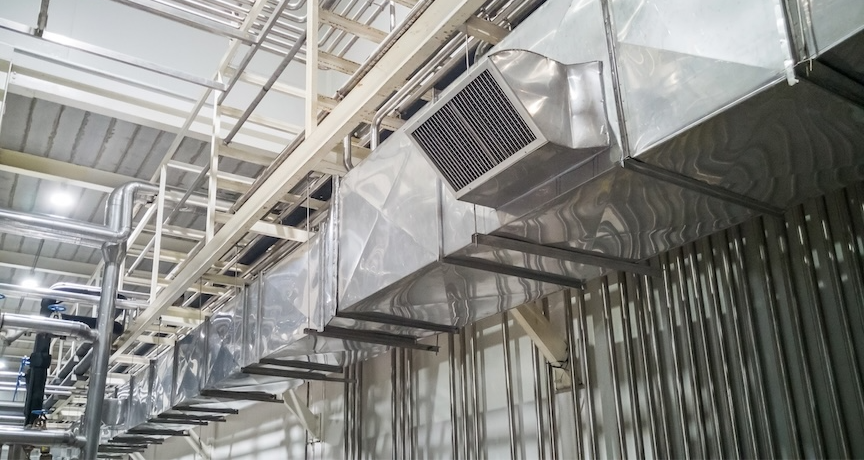
Achieving that level of control requires a cleanroom HVAC system specifically designed for the application. Standard commercial HVAC units aren't built for this kind of precision. Cleanroom HVAC systems are engineered with redundancy, fine-tuned controls, and the capacity to handle the heat loads generated by equipment running continuously in a sealed environment. Proper heat load analysis during the cleanroom design phase is what prevents expensive retrofits later on.
Humidity: The Silent Variable
Temperature tends to get more attention, but humidity control is equally important and sometimes harder to manage. Relative humidity affects everything from static electricity buildup to material adhesion, corrosion rates, and even operator comfort.
When humidity drops too low, electrostatic discharge (ESD) becomes a serious risk that can destroy sensitive electronic components instantly. Dry environments also tend to generate more particulate as materials become brittle. On the other end of the spectrum, too much moisture leads to condensation on equipment surfaces, accelerated corrosion, and in pharmaceutical or biotech clean rooms, conditions that can promote microbial growth. Moisture can also interfere with adhesives, coatings, and chemical processes in ways that directly compromise product integrity.
How HVAC and Air Filtration Work Together
Temperature and humidity don't exist in isolation. They're managed together through an integrated approach to cleanroom HVAC and air filtration systems. The goal isn't just to deliver air at the right temperature — it's to deliver the right volume of conditioned, filtered air in a way that maintains pressure differentials, controls contamination, and keeps environmental parameters stable.
HEPA filters are a cornerstone of clean room air filtration. These filters are rated to capture 99.97% of particles 0.3 microns or larger, making them highly effective at removing airborne contaminants. But HEPA filters work best as part of a properly engineered air filtration system, not as an afterthought. The number of air changes per hour, the placement of supply and return air, and a consistent filter maintenance schedule all determine how well the system performs over time.
Controlled environments are also designed with positive or negative pressure differentials depending on what needs to be protected. A pharmaceutical cleanroom might use positive pressure to keep contaminants from entering adjacent spaces, while a facility handling hazardous materials might use negative pressure to prevent any release to the outside. Getting these pressure relationships right is a core part of cleanroom design.
Industries That Depend on Controlled Environments
Sensitive manufacturing spans more industries than most people realize. Some of the most common sectors that rely on precisely controlled cleanrooms include semiconductor and microelectronics fabrication, pharmaceutical and biopharmaceutical production, medical device manufacturing, aerospace and defense component assembly, and advanced battery manufacturing. Each of these industries has its own regulatory requirements and environmental standards, which is why cleanroom construction and cleanroom engineering can't follow a one-size-fits-all approach.
Common Challenges in Cleanroom Construction and Design
Building a controlled environment for sensitive manufacturing is genuinely complex. Common challenges during cleanroom construction include managing the transition between construction and operational phases, coordinating specialized HVAC installation with the broader building structure, and ensuring that mechanical, electrical, and plumbing systems integrate without compromising the clean room envelope.
Wastewater management is another consideration that's easy to overlook early on. Many manufacturing processes generate wastewater that can't be discharged to a standard municipal system, so dedicated treatment systems that meet local and federal regulations are often required. Construction management in this context also demands that schedules account for commissioning and validation periods, and that materials meet cleanliness standards throughout installation.

How DesignTek Consulting Approaches Sensitive Manufacturing Facilities
At DesignTek Consulting, our approach to sensitive manufacturing facilities is built on collaboration across engineering disciplines. From initial cleanroom design through construction management and commissioning, we work to make sure that temperature control, humidity management, HEPA filtration, and cleanroom HVAC systems are designed as an integrated whole rather than a collection of separate systems.
If you're planning a new sensitive manufacturing facility or looking to upgrade an existing controlled environment, we'd love to talk through what your project needs. Explore our services to learn more about how DesignTek can support your cleanroom project from concept through completion, and contact us to start the conversation.


Comments